
Your Data Stays Your Data: AI Testing Without Giving Up Sovereignty
Many AI testing tools are impressive, until legal asks where the test data actually goes. Why that's a showstopper for European companies, and how it can work differently.
- gdpr
- datasovereignty
- ai
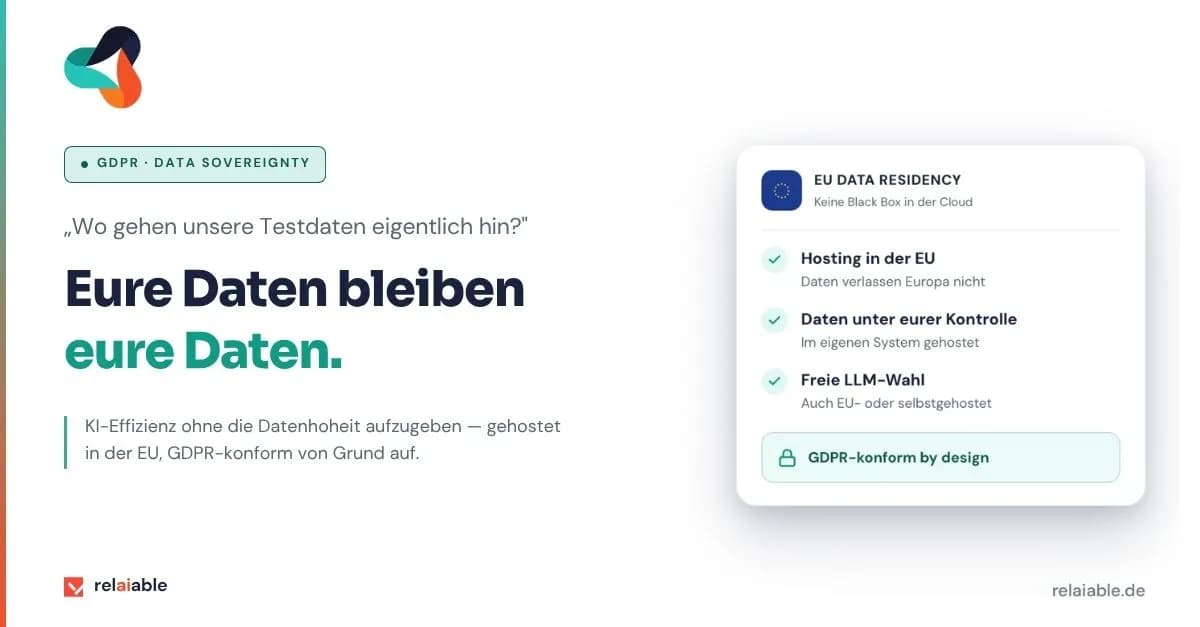
Many AI testing tools look impressive at first glance. Then the legal team asks a single question: "Where does our test data actually go?" For most tools out of the US, the honest answer is: into a black box in the cloud. For European companies with GDPR obligations, that isn't a detail but a showstopper. The good news is that AI efficiency and data sovereignty don't rule each other out.
The question that decides everything
An AI testing tool looks great in the demo. Tests appear in minutes, failures are analysed automatically, the pipeline runs. But the moment it comes to rollout, the question arrives from compliance, data protection or IT security: which data leaves our system, and where exactly does it go? Test data is rarely harmless. It often contains customer records, personal information, configurations or business logic that your company doesn't want sitting in someone else's data centre.
This is where many promising tools fail in practice. Not because the AI is bad, but because nobody can say for certain where the data ends up and who has access to it.
The black box in the cloud
With many AI testing tools, especially from the US market, test data is sent to a hosted cloud platform for processing. What happens there in detail is hard to trace from the outside. Where are the servers? Is data cached? Does it feed into model training? Who has access, and under which jurisdiction?
For teams that must comply with GDPR, this lack of transparency is the real problem. The regulation asks for more than encrypting data. It asks you to prove where personal data is processed, on what legal basis and with which safeguards. A black box can't be audited, and what can't be audited can't be deployed with a clear conscience in a regulated environment.
Why we built relaiable differently
We built relaiable from the ground up for European requirements, not as a compliance layer bolted on afterwards but as an architectural principle. In concrete terms:
- Hosted at the customer. relaiable runs directly in your system. Test data never leaves your environment and doesn't wander into someone else's cloud.
- Data under your control. You keep sovereignty over your data, with a clear separation between test data and platform telemetry and traceable data flows.
- Free choice of LLM. You decide which language model is used, including EU-hosted or self-hosted models. No dependency on a proprietary black box.
The difference is fundamental: instead of sending the data to the tool, the tool comes to the data. Processing stays where it belongs and can be cleanly documented and audited for compliance teams.
| Criterion | Typical cloud tools | relaiable |
|---|---|---|
| Where does test data live? | External cloud, often outside the EU | In your own system, in the EU |
| LLM choice | Fixed | Free, self-hosted possible |
| Auditability | Limited (black box) | Traceable data flows |
AI efficiency without compromising data protection
The supposed trade-off between modern AI and strict data protection is, in the end, a question of architecture. If you build on data sovereignty, EU hosting and free model choice from the start, you don't have to choose between efficiency and compliance. AI efficiency doesn't have to mean giving up data sovereignty.
One question to close: how do you currently balance AI adoption with data protection? If today's answer is "not all that well", it's worth looking at how much of that comes down to a pure architecture decision.